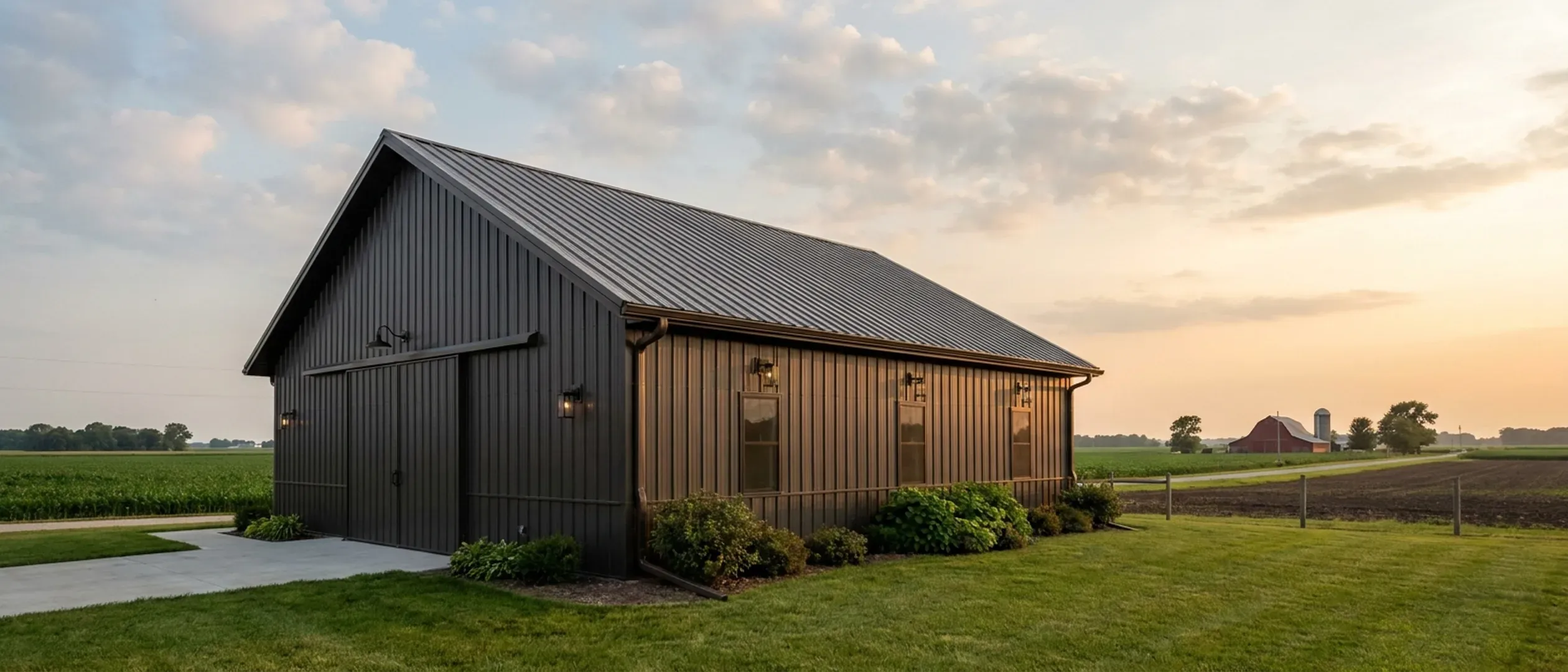
Are Barndominiums Worth It? An Indiana Decision Guide
"Is a barndominium worth it" is less a question about the building than about the person building it. The same structure is a sound decision for someone who needs a forty-foot equipment bay and plans to stay twenty years, and a poor one for someone buying a lot in a covenanted subdivision who expects to sell in four. This guide does not argue a side. It puts the published Indiana numbers on the table — what contractor-built houses cost in the Midwest according to the Census Bureau, what Indiana land costs according to Purdue and USDA, what a typical Indiana home is worth according to Zillow — and then works through what those numbers mean for a barndominium, including the part most sales pages leave out: that building new usually costs more than buying an existing house, and that appraisal depends on comparable sales that are thin in some rural counties. None of the figures here are ours. We publish no prices of our own; every number carries the name of the organization that published it. What we can do is show where a barndominium's value really comes from — mostly from putting a house and a large, useful shop under one roof on land you choose — and where it does not. If you want the list of structural trade-offs, that is the pros and cons guide; if you want the legal questions, that is the Indiana legal guide.
Figures on this page are cited third-party or government data, not a quote from Indiana Barndominium Builders.
Bottom Line Up Front
- A barndominium is worth it when you need shop, garage or equipment space you would otherwise build separately, and when you plan to own the property long enough that resale variability matters less than daily use.
- It is rarely worth it as a way to get a cheaper house than you could buy: the Census Bureau's 2025 median contract price for a contractor-built Midwest house was $457,200 excluding the lot, while Zillow's typical Indiana home value was about $260,000 in August 2026.
- The questions that settle most cases are how long you will own it, whether local design standards and covenants allow it, and whether an appraiser can find comparable sales near your land.
Where the answer is clearly yes
These situations are where a barndominium's real advantages line up with what the owner actually needs.
You need a shop you would otherwise build separately
If your plan was always a house plus a pole barn, a barndominium puts both under one roof, on one foundation, inside one envelope, with one set of permits. That consolidation is the strongest value case for the building type, and it does not depend on any per-square-foot claim.
You are staying a long time
Over a long ownership, what the building does for you every day matters more than how a future appraiser values it. Resale variability is a cost you pay only once, at the end; a workshop, equipment bay or home business space is a benefit you use for years.
You already own suitable land
If the land is paid for, zoned for a dwelling, free of restrictive covenants and able to take a septic system, the largest risks of the project are already settled. The decision then turns on the building alone.
You want a layout you cannot buy
Clear-span interiors, very tall garage bays and combined living and working space are seldom on the market as existing homes. When the house you want does not exist to buy, building it is the only route, and the comparison with a cheaper existing house stops being relevant.
Your land has room and few design rules
Rural parcels in agricultural or rural-residential districts, outside platted subdivisions, are where a barndominium fits most comfortably. Check the specific district's rules; they vary within a county.
You will document the build properly
An owner who keeps the permits, a sealed structural design, the septic approval and dated photographs of every stage hands a future buyer and appraiser the evidence they need. That protects value in any county, and especially where no local building department inspects.
Where the answer is no, or not yet
These are the situations where the building type works against the owner. Some can be fixed; some cannot.
You expect to sell within a few years
Building new carries costs you do not recover quickly — design, permits, site work, septic, well and utilities — and a barndominium's buyer pool may be narrower than a conventional house's in the same area. On a short horizon those are the parts of the equation that dominate.
You want the cheapest possible house
The published numbers do not support a barndominium as a shortcut to a cheap house. The Census Bureau's 2025 median contract price for a contractor-built Midwest house was $457,200 before land, while Zillow put the typical Indiana home value at about $260,000 in August 2026. New construction of any kind usually costs more than buying an existing home, and a barndominium's shell changes only part of the construction budget.
The lot is in a covenanted subdivision or a town with design standards
If the recorded covenants or the town's architectural design standards restrict metal exteriors or roof pitch, a barndominium may not be allowed at all, or only with finishes that remove much of its cost advantage. Check before buying.
The land cannot take a septic system
Under 410 IAC 6-8.3, the county health department must issue a written septic construction permit before construction of a residence starts, based on a soil scientist's description of the site. Poor soils can mean an engineered system or no permit. Buying land before that check is the most common way a rural build goes wrong.
Resale and appraisal, stated honestly
There is no published Indiana figure for barndominium resale values, and anyone quoting a percentage premium or discount has not got it from a public data source. What can be said is how the valuation works.
Appraisers value what they can compare
An appraisal rests on comparable sales. Fannie Mae's guidance recognizes that rural properties may have no truly comparable recent sales nearby, and lets the appraiser reach further afield with an explanation. Where several barndominiums or post-frame homes have sold in the area, valuation is straightforward; where none have, the appraiser adjusts from conventional homes, and the result is less predictable.
Land often carries much of the value
On a rural parcel, the land and site improvements can be a large share of what a buyer pays. NAHB's national survey found the finished lot was 13.7% of the average new-home sales price in 2024, but a rural barndominium on several acres at the land prices Purdue and USDA report will usually carry a larger share. Acreage in a desirable location tends to hold its value whatever building sits on it.
Finish level matters more than frame type
A buyer and an appraiser look at the living space: bedrooms, bathrooms, kitchen, finishes, heating and cooling, and condition. A barndominium finished to the standard of comparable homes nearby is valued accordingly. One with an oversized shop and a minimal living area is valued mostly on the living area and the land.
Documentation protects value
A buyer's lender, inspector and insurer will want evidence the house was built to the 2020 Indiana Residential Code. Where a local building department issued permits and inspected, the permit file supplies it. Where none exists, the owner's own records — sealed drawings, inspection reports and photographs — are what stand in for it.
Insurance and running costs
Part of whether a building is worth it is what it costs to keep. These points are general; get quotes for your own design.
Insurance
Insurers rate buildings by construction type, occupancy and replacement cost. A combined dwelling and shop, a post-frame structure, or a shop used for a business may be rated differently from a conventional house, and some carriers write them more readily than others. Get quotes before you finalize the design, describe the shop's use accurately, and make sure the dwelling is covered as a dwelling at replacement cost.
Energy
Indiana's energy rules in 675 IAC 14-4.4 require R-38 ceilings in both of the state's climate zones, and wall insulation of R-15 in zone 4 or R-20 (or R-13 plus R-5 continuous) in zone 5. A barndominium built to those levels, with careful air sealing, heats and cools like a comparable house. A large shop bay that is heated adds to the bill in proportion to its volume.
Maintenance
A well-specified metal roof and siding need little routine maintenance compared with painted siding or shingles. The items to watch are fasteners and sealants, flashing at openings, gutters and grading, and on post-frame buildings the drainage around the columns.
Property tax
The county assessor determines the assessed value of the dwelling and the shop. Ask the assessor how a combined house-and-shop building is valued in your county before you finalize the size of the shop, because a large finished shop adds to the improvements being assessed.
Questions that settle it
Work through these before you commit to land or a design. Most people find the answer is clear by the end.
How long will you own it?
Ten years or more makes resale variability a small concern; under five makes it a large one.
Would you build a shop anyway?
If yes, the consolidation value is real. If no, you are paying for volume you may not use.
Does the land allow it?
Check the zoning district, any architectural design standards, the recorded covenants, septic feasibility and floodway status. The legal guide lists the checks in order.
Can an appraiser find comparables?
Ask a local appraiser or lender whether similar homes have sold nearby. If a construction loan is involved, this question decides the loan amount.
What does land cost where you want to build?
Use Purdue's and USDA's figures as a sense-check, not a price. A parcel's value depends on location, road frontage, soils and whether it can be split.
Will the design meet your county's loads?
The state's county table sets ground snow load, footing depth and seismic design category. A plan drawn for a different state's loads is a false saving.
Reading this because you are weighing a build? The next step is a plan drawn for your program.
What's different about Indiana
What a contractor-built house costs in the Midwest
The Census Bureau's Survey of Construction publishes contract prices for new single-family houses built by a contractor on the owner's land — the closest published analogue to building a barndominium on your own acreage. For houses started in 2025 in the Midwest region, which includes Indiana, it reports a median contract price of $457,200 and a median of $194.09 per square foot, with an average of $202.13 per square foot. Both exclude the value of the lot. The Census Bureau publishes these figures by region, not by state.
What Indiana's building permits say
The Census Bureau's Building Permits Survey reports that Indiana issued 19,877 permits for single-unit homes in 2025 with a combined reported construction value of about $7.27 billion — an average permit valuation of roughly $365,900 per home, excluding land. Permit valuations are what applicants declare, so treat that as a declared-value benchmark rather than a measured cost.
What Indiana land costs
Purdue's 2026 Farmland Values and Cash Rent Survey reports that the average price of top-quality Indiana farmland was $14,909 per acre in June 2026 and average-quality farmland $12,121. The survey prices transition land — land moving out of production agriculture into other, typically higher-value uses such as homesites — at $27,260 per acre, and recreation land at $9,043. USDA's Land Values 2026 Summary puts Indiana farm real estate — land and buildings — at $9,150 per acre. Purdue notes its values are averages over different locations and soil types; a specific parcel needs its own appraisal.
What a typical Indiana home is worth
Zillow reports that its Home Value Index for Indiana — the typical value of homes in the middle of the market — was about $260,000 in August 2026, up about 3% from August 2025. That is a value for existing homes of every age and size, not a construction cost, but it is the number your eventual buyers will compare against.
How appraisers handle rural property
Fannie Mae's Selling Guide tells appraisers that rural properties often have large lots in relatively undeveloped locations, so there may be a shortage or absence of recent truly comparable sales in the immediate vicinity. It allows more distant sales to be used where they produce credible results, with an explanation. For a barndominium in a county with few similar sales, that is the mechanism that decides how the house is valued for a loan or a resale.
Local rules that shape resale
Indiana bars local building rules stricter than the state code, but leaves architectural design standards and zoning to cities, towns and counties (IC 22-12-2.5-5(a)), and recorded covenants can restrict metal exteriors. A barndominium built where those rules allow it can be sold to anyone; one built in breach of a covenant or without the required local approvals becomes a problem at the title and inspection stage of a sale.
Pros and cons, honestly
Pros
- One foundation, roof and envelope over the house and the shop is a genuine saving compared with building both separately.
- Over a long ownership, daily usefulness outweighs resale variability.
- Clear-span layouts, tall bays and combined living and working space are hard to find in Indiana's existing-home market.
- Well-specified metal roofing and siding keep routine maintenance low.
- Built to the 2020 Indiana Residential Code, it is a Class 2 dwelling in law like any other house.
- On rural acreage, much of the property's value sits in the land, which holds its value regardless of the building.
Cons
- Building new of any kind usually costs more than buying an existing Indiana home; the Census and Zillow figures show the gap.
- Appraisal can be less predictable where few comparable sales exist, which can affect construction loans and resale.
- The buyer pool for a particular house-and-shop combination can be narrower than for a conventional house.
- Design standards and covenants can rule out a barndominium on some lots entirely.
- Site work, septic, well and utilities on raw land add costs that an existing house has already absorbed.
- Insurance may be rated differently for combined dwelling-and-shop buildings or business use.
- Where no local building department inspects, the owner has to create the documentation a buyer will want.
- There is no public Indiana data on barndominium resale values, so no percentage premium or discount can be relied on.
Are barndominiums worth it in Indiana?
Is it cheaper to build a barndominium than to buy a house in Indiana?
Do barndominiums hold their resale value?
Why is appraising a barndominium harder?
How much does land cost for a barndominium in Indiana?
What does it cost per square foot to build a house in Indiana?
Are barndominiums harder to insure?
Who should not build a barndominium?
Questions answered? Tell us what you want to build and we will put real numbers against it.
Keep reading
The pages that answer the next question this one raises.
Barndominium pros and cons
The structural trade-off list for Indiana: snow and frost by county, condensation, design standards and more.
Read itBarndominium cost in Indiana
Third-party cost benchmarks and the line items that decide a barndominium budget.
Read itBarndominium vs house cost
The numbers-only comparison between a barndominium and a conventional house.
Read itAre barndominiums legal in Indiana?
The statewide code, local zoning and design standards, covenants, septic and floodway checks.
Read itShouses
Shop-plus-house layouts — where most of a barndominium's value case comes from.
Read itStart your project survey
Tell us about your land, your shop needs and your timeline, and we will tell you honestly whether this building type fits.
Read itSources
- U.S. Census Bureau — Characteristics of New Housing: contract price per sq ft (2025)
- U.S. Census Bureau — Characteristics of New Housing: contract price (2025)
- U.S. Census Bureau — Building Permits Survey, state annual (2025)
- Purdue Agricultural Economics Report: Indiana farmland values (2026) — Purdue University
- USDA NASS — Land Values 2026 Summary
- Zillow Home Value Index by state (data file)
- Selling Guide B4-1.3-08, Comparable Sales — Fannie Mae
- Cost of Constructing a Home in 2024 — NAHB Eye on Housing
- 675 IAC 14-4.4-91 (Indiana Residential Code, Table N1102.1.2 insulation by climate zone) — Cornell LII
- Indiana Code Title 22 (2026) — Indiana General Assembly
- 410 IAC 6-8.3 Residential On-Site Sewage Systems (rev. 28 Mar 2024) — Indiana Department of Health
Want a real number instead of a range?
Start your plans and we will come back with a budget for what you actually want to build, not a national average. Send the parcel ID or an address when you have one and we will price it against your land. That conversation costs nothing.