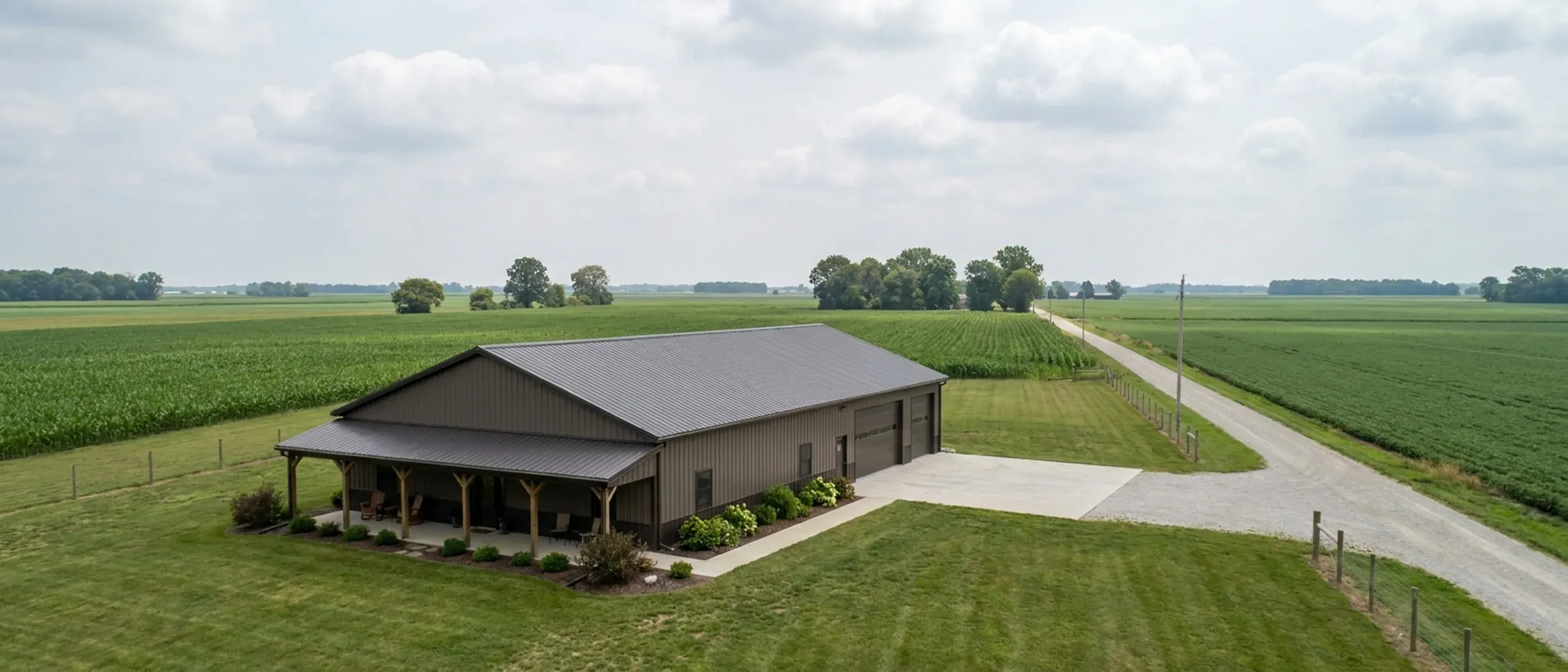
How Much Does a Barndominium Cost in Indiana?
The U.S. Census Bureau's 2025 Survey of Construction puts a house built under contract on the owner's own land in the Midwest at a median $194.09 per square foot (average $202.13), lot excluded: a median contract of $457,200. Census permit data put Indiana's 2025 new single-family homes at about $365,900 of declared construction value each. Land comes on top. Purdue's 2026 survey puts farmland moving into other uses at $27,260 an acre. No agency publishes a barndominium-only figure. These are the closest measured numbers, and the rest of this page covers the county-level items that move them.
Figures below are industry data from cited third-party sources, not a quote from Indiana Barndominium Builders. Every project is priced individually.
Bottom Line Up Front
- Per square foot: the Census Bureau's 2025 figure for Midwest houses built under contract on the owner's land is a median $194.09 and an average $202.13, lot excluded. That covers all contractor-built houses, not barndominiums alone, and it is the closest government figure to a barndo built on your own acreage.
- Indiana-specific: Census permit data put 2025 Indiana single-family permits at about $365,900 of declared value per home, with county averages of about $179,000 in Lawrence County and about $495,000 in Boone County. Land is extra. Purdue's 2026 survey reports $27,260 an acre for farmland moving into other uses, and $14,909 for top-quality farmland.
- What moves your number: the state code table lists Allen County at a 36-inch footing depth, Marion County at 30 inches and Vanderburgh County at 24, and puts Lake, St. Joseph, Elkhart and 13 other northern counties at a 30 psf ground snow load. Septic soils, the well, the driveway and karst in the south-central counties add more. Send us the parcel and we will price that site.
Cost per square foot: published benchmarks
Each row is a published figure with its source, not a quote. Your county's footing depth, snow load, septic and site work move your number from here.
| Benchmark | Range | Source |
|---|---|---|
| Midwest house built under contract on the owner's land, 2025 (median to average) | $194.09–$202.13 per sq ft, lot excluded | U.S. Census Bureau, Survey of Construction, Characteristics of New Housing 2025: median and average contract price per square foot, Midwest region (contract price excludes value of improved lot). https://www.census.gov/construction/chars/xls/contractpricesqft_cust.xls (read 26 Sep 2026) |
| Midwest new detached house sold by a builder, 2025 (median to average) | $160–$169.78 per sq ft, lot excluded | U.S. Census Bureau, Survey of Construction 2025: median and average price per square foot of floor area, detached new single-family houses sold, Midwest region (excludes value of improved lot). https://www.census.gov/construction/chars/xls/soldpricesqft_cust.xls (read 26 Sep 2026) |
Estimate a range for your square footage
Pick a size and a tier and this multiplies them against the same industry ranges printed in the table above, nothing new, nothing ours. It's a starting orientation, not a quote.
Estimated range
$0 – $0
This estimate comes from the industry cost data cited in the table above, not from Indiana Barndominium Builders. It doesn't account for your site, county, or finish choices, all of which move the real number. Send us the parcel for one that does.
Total cost by size
Rough totals at common sizes. These move with everything on this page, so treat them as a starting orientation, not an estimate for your project.
1,500 sq ft
$291,135–$303,195
Arithmetic, not a quote: 1,500 sq ft x the Census 2025 Midwest contract-built median ($194.09) and average ($202.13) per sq ft. Lot, well, septic and driveway not included. https://www.census.gov/construction/chars/xls/contractpricesqft_cust.xls
2,000 sq ft
$388,180–$404,260
Arithmetic, not a quote: 2,000 sq ft x the Census 2025 Midwest contract-built median ($194.09) and average ($202.13) per sq ft. Lot, well, septic and driveway not included. https://www.census.gov/construction/chars/xls/contractpricesqft_cust.xls
2,400 sq ft
$465,816–$485,112
Arithmetic, not a quote: 2,400 sq ft (a 40x60 footprint) x the Census 2025 Midwest contract-built median ($194.09) and average ($202.13) per sq ft. Lot, well, septic and driveway not included. https://www.census.gov/construction/chars/xls/contractpricesqft_cust.xls
3,000 sq ft
$582,270–$606,390
Arithmetic, not a quote: 3,000 sq ft x the Census 2025 Midwest contract-built median ($194.09) and average ($202.13) per sq ft. Lot, well, septic and driveway not included. https://www.census.gov/construction/chars/xls/contractpricesqft_cust.xls
What actually moves the number
Footing depth: 24, 30 or 36 inches by county
Indiana's residential code replaces the national design table with a 92-county table (675 IAC 14-4.4-5, Table R301.2(1)), and its footing-depth column comes in three depths. The table lists Allen, Lake, St. Joseph, Elkhart, Wabash and 22 other northern counties at 36 inches, Marion, Hamilton, Boone, Tippecanoe and 25 other central counties at 30 inches, and Vanderburgh, Monroe, Lawrence, Vigo and 32 other southern counties at 24 inches. On a post-frame or steel building that depth applies to every post hole or pier and to the frost wall under a slab. The same building needs half as much again below grade in the northern band as in the southern one.
Snow load: 30 psf in 16 northern counties
The same state table lists Lake, Porter, LaPorte, St. Joseph, Elkhart, LaGrange, Steuben, DeKalb, Noble, Kosciusko, Marshall, Starke, Pulaski, Fulton, Jasper and Newton counties at a 30 psf ground snow load, and the other 76 counties at 20 psf. Trusses, purlins and roof panels are sized to that number, and Eversafe Buildings' own product page says its prices for regions prone to heavy snow loads may be higher. Allen, Whitley and Wabash counties are in the deepest footing band but only the 20 psf snow band, so the two figures do not always move together.
Septic: the soil decides the system
In a September 2000 Purdue news release, Purdue attributed to the Natural Resources Conservation Service the finding that 79 percent of Indiana soil is unsuitable for traditional septic systems. The figure is dated, but Purdue's drainage guide describes the same wet, tile-drained ground: the state's 35 percent share of tile-drained cropland is the highest in the nation. On a rural lot the soil profile a soil scientist writes up decides whether a conventional trench field works or a mound or other engineered system is needed, and that swing is often bigger than any finish choice inside the house.
Karst in the south-central counties
INDOT's karst guidance says the Mitchell Plateau extends from the eastern part of Owen County southward to the Ohio River in Harrison County, and that the northern two-thirds of the state sit under thick glacial material. In the karst belt (Lawrence, Monroe, Orange and Harrison counties among them) sinkholes, caves and springs are common. That makes a geotechnical look at the building pad and the septic field a sensible line item before you commit to a footprint. A DNR study of Lawrence County notes that karst areas are extremely vulnerable to contamination from household septic systems.
What each published number actually measures
Four government or trade figures come up when people price a build in Indiana. Each one measures something different, and mixing them up is how estimates go wrong.
Census: $194.09 per square foot, Midwest, owner's land (2025)
The Census Bureau's Survey of Construction reports a median contract price of $194.09 per square foot, and an average of $202.13, for single-family houses started in 2025 in the Midwest under a contract on land the owner already had. It excludes the value of the lot. That is the setup of most barndominium projects: you own or buy the acreage, then contract the building. The Census reports a median contract price for those Midwest houses of $457,200 (average $546,100). The Census publishes this by region only, so there is no Indiana-only or East North Central version. It also covers all contractor-built houses, not steel or post-frame homes specifically.
Census: $160 per square foot for spec houses sold (2025)
For contrast, the Census reports a 2025 Midwest median of $160.00 per square foot (average $169.78) for new detached houses sold by builders, again excluding the lot. Spec houses are built in volume on subdivision lots. That is a large part of why they come in below a one-off contract build on rural land, and why the Census $160 figure is the wrong benchmark for a custom barndominium.
Census permits: about $365,900 per Indiana home (2025)
The Census Bureau's Building Permits Survey reports that Indiana issued 19,877 single-family permits in 2025, with a declared construction value of $7.27 billion, or about $365,900 per home. By county, the same Census file works out to about $179,400 in Lawrence County (84 homes), $285,200 in Vanderburgh, $364,300 in Allen, $372,600 in Marion, $404,200 in Hamilton, $436,800 in Monroe and $494,700 in Boone County (907 homes). Those are values applicants declared on permit applications, not audited costs. Size and finish differ from county to county, which is why the spread is so wide.
NAHB: where the money goes inside a house
NAHB's 2024 Cost of Constructing a Home survey (national only) reports that interior finishes take 24.1 percent of construction cost, major system rough-ins 19.2 percent, framing 16.6 percent, exterior finishes 13.4 percent, foundations 10.5 percent and site work 7.6 percent. A steel or post-frame shell changes the framing and exterior lines, roughly 30 percent of the total. Kitchens, baths, plumbing, wiring and HVAC cost about the same inside a barndominium as inside a stick-built house. That is why a barndo shell does not halve the price of a finished home.
Land: the line the per-square-foot figures leave out
The Census figures above exclude the lot. In Indiana the acreage is often the second-largest check you write, and the acre price depends heavily on which kind of land you are buying.
Purdue 2026: $27,260 an acre for land leaving farming
Purdue's 2026 Farmland Values and Cash Rent Survey (August 2026) reports transition land, defined as land moving out of production agriculture into other, typically higher-value uses, at $27,260 an acre statewide, down 6.1 percent from 2025. This is the closest published figure to what a farm parcel split off for a homesite sells for. The survey's own authors note that it lumps residential, commercial and industrial conversions together, so treat it as a benchmark rather than a price.
Purdue 2026: $14,909 for top farmland, $9,043 for recreation land
The same survey reports top-quality farmland at $14,909 an acre (up 0.6 percent), average-quality at $12,121 and poor-quality at $9,460. Purdue reports recreation land, meaning rural ground used for hunting and similar uses, at $9,043. A wooded or rolling parcel in the Southern Hills is usually priced against the recreation and poorer-farmland figures. A flat, tillable tract near Indianapolis or Fort Wayne is priced against the higher ones or against transition land.
USDA 2026: $9,150 farm real estate, $8,600 cropland
USDA's National Agricultural Statistics Service, in its Land Values 2026 Summary released July 31, 2026, reports Indiana farm real estate (land and buildings) at $9,150 an acre and cropland at $8,600 an acre. Some news summaries have reported the $9,150 figure as cropland, which is wrong. Both are statewide averages across whole farms, so a five-acre homesite rarely sells at either rate. The Purdue transition figure is closer to what small parcels bring.
Kit and shell prices: two manufacturers' own list prices
No neutral body publishes barndominium kit prices. Below are two manufacturers' own published prices for a 40x60 building, read on their websites on 26 September 2026. They are those companies' list prices, not our numbers, and they are not averaged with anything else on this page.
Hansen Buildings: $64,708.25 for a 40x60x12 barndominium kit
Hansen Buildings lists its 40x60x12 Barndominium Kit at a current price of $64,708.25, marked down from $68,112.99. The listing says the kit includes two entry doors, a patio door, seven windows, wall girts, ceiling-load trusses, a ridge vent and housewrap, and that engineering and delivery are included. The listing does not include the foundation, erection labor, insulation, drywall or anything inside the walls.
Eversafe Buildings: from $58,426 for a 40x60x16 steel barndominium
Eversafe Buildings lists its 40x60 Steel Barndominium at a retail price from $58,426. The page says prices vary by state, location and customization, that regions prone to heavy snow loads may cost more, and that delivery and installation on your pad are included. The concrete pad itself, the interior build-out, utilities and site work are separate.
What those two prices tell you
Put either list price next to the Census arithmetic for the same 2,400 square feet ($465,816 at the Midwest median). The shell comes to roughly one-seventh to one-eighth of the finished house. The rest is foundation, erection, insulation, mechanical systems, interior finishes and site work, the lines NAHB's survey shows making up most of construction cost. A kit price is a useful number for a shell, a shop or a shouse's garage half. It is not the cost of a finished home, and anyone quoting a per-square-foot house price built from kit prices is leaving most of the house out.
A worked example: 2,400 square feet on five acres
This is arithmetic on the cited figures above, not a quote and not our pricing. It shows how the published numbers combine for a 40x60 footprint on a five-acre parcel.
Building: $465,816 to $485,112
2,400 square feet x $194.09 (Census 2025 Midwest contract-built median per square foot) = $465,816. At the Census average of $202.13, it is $485,112. Both exclude the lot. The Census does not break out how much of a contract went to the well, septic system or driveway, so do not assume those are covered.
Land: $45,750 to $136,300
5 acres x $9,150 (USDA NASS 2026 Indiana farm real estate average) = $45,750. 5 acres x $27,260 (the Purdue 2026 survey's transition-land average) = $136,300. The second is closer to what a split-off homesite sells for, and a parcel near a growing suburb can sell well above either figure.
Building plus land: about $511,600 to $621,400
Adding the two lines gives $511,566 at the low pairing (Census median plus USDA acreage) and $621,412 at the high pairing (Census average plus Purdue transition land). Wells, septic systems, driveways and power runs vary so much by parcel that no neutral source publishes a statewide figure for them. On many rural lots they add more than the permit fees and finish upgrades combined, which is why the total above is a floor, not a ceiling.
Permit fees are the small line
Two published schedules for scale. The Wabash County Plan Commission's fee schedule, effective May 8, 2026, lists $0.07 per square foot for a new residential structure, so $168 for 2,400 square feet. The Marshall County Health Department lists a $60.00 septic permit fee for new construction. Both are real, but neither will change which parcel or plan you can afford. The footing depth, the septic soils and the land price will.
What to pin down before anyone prices your build
Each of these is published or measurable, free or cheap to get, and changes the number more than any national average does.
Your county's row in the state design table
Look up your county in 675 IAC 14-4.4-5, Table R301.2(1): footing depth, ground snow load, seismic category and whether an ice-barrier underlayment is required. Those four entries set the foundation and roof package. A detached shop of 721 square feet or less can skip frost-depth footings under the state's frost-protection section, but the house cannot.
A soil profile for the septic field
The county health department issues the septic permit. In Marshall County, for example, a soil scientist bores at least three holes where the field will go, and the resulting soil profile analysis is good for seven years if the area stays undisturbed. Get it before you close on land if the seller will allow it. It tells you whether the lot takes a conventional system or needs a mound, and some lots take neither.
The well, the driveway and the power run
None of these scales with floor area, and no neutral body publishes an Indiana figure for them. Ask the nearest well driller for typical depths in that township, ask the utility for the cost to bring service from the road, and measure the driveway length. On acreage set back from the road, these three lines can rival the cost of the shell.
Zoning and the improvement location permit
Many county and city plan commissions issue an improvement location permit (a zoning permit) separate from the building permit, and the zoning ordinance can set minimum lot sizes, setbacks and exterior-material rules for a house in an agricultural district. Check the district before you buy, because a parcel that cannot take a residence at the size you want has a very different value.
A site-specific estimate
Send us your parcel and floor-plan ideas. We price a build against that county's table row, that lot's soils and access, and the plan you actually want, rather than a regional average. The figures on this page are the benchmark to check our estimate against.
Reading this because you are weighing a build? The next step is a plan drawn for your program.
What's different about Indiana
One statewide code, enforced locally
Every Indiana house is designed to the 2020 Indiana Residential Code (675 IAC 14-4.4, based on the 2018 IRC), and the Department of Homeland Security says there is no place in the state where it is not in effect. Permits and inspections are issued by the city, town or county, and so are the fees. The zoning permit (an improvement location permit) and the septic permit usually come from two more offices. The code is the same across county lines, but the fee schedule and who reviews your drawings change.
Seismic Design Category C in 14 southwestern counties
The state table places Posey, Vanderburgh, Warrick, Gibson, Knox, Daviess, Dubois, Monroe and six other counties in Seismic Design Category C, Marion and 30 others in B, and the rest in A. CUSEC says the Wabash Valley Seismic Zone, in southeastern Illinois and southwestern Indiana, is capable of producing M7.0 earthquakes. For a home in a Category C county, bracing and connection details are part of the structural design, and that shows up in the drawings and the steel or lumber list.
Two energy-code climate zones
The state's amended insulation table has rows for climate zone 4 and zone 5. The Department of Energy's county list puts 30 southern counties, from Vanderburgh and Posey to Clark, Floyd, Monroe and Lawrence, in zone 4A and the other 62 in zone 5A. In the amended table a wood-frame wall in zone 4 needs R-15, and in zone 5 it needs R-20 or R-13 plus R-5 continuous. A barndominium's wall section and spray-foam budget depend on which zone the county falls in.
Land prices move by region, not just by year
Purdue's 2026 farmland survey reports that the North and Northeast regions posted the steepest declines in 2026, while the Southwest posted the largest price increases. Its authors also say a statewide average masks that spread. Its footnote says the values represent averages over several different locations and soil types, and that an individual tract needs an appraiser. Use the statewide acre figures on this page for scale, and a local sale or appraisal for the parcel you are actually buying.
How much does a barndominium cost in Indiana?
What is the cost per square foot to build a barndominium in Indiana?
How much does it cost to build a 2,000 square foot barndominium in Indiana?
How much is land for a barndominium in Indiana?
How much does a barndominium kit cost in Indiana?
Is it cheaper to build a barndominium in southern Indiana than northern Indiana?
Is a barndominium cheaper than a regular house in Indiana?
How do I get an accurate price for my land?
Questions answered? Tell us what you want to build and we will put real numbers against it.
Keep reading
The pages that answer the next question this one raises.
Get a number for your parcel
Tell us the county, the acreage and the plan you have in mind, and we will price that site rather than a regional average.
Read itBarndominium vs. house cost
Which lines a steel or post-frame shell actually changes, and which cost the same in either building.
Read itWhat size can I build for my budget?
Working backwards from a budget to a footprint, once land and site work are taken off the top.
Read itFinancing a barndominium
Construction loans, appraisals and what a lender needs to see before it funds a build on acreage.
Read itSite preparation
The part of a rural build that does not scale with floor area: driveway, pad, drainage, well and septic.
Read itBarndominium kits
What a shell package includes, what it leaves out, and how it fits a finished-home budget.
Read itSources
- U.S. Census Bureau — Characteristics of New Housing: contract price per sq ft (2025)
- U.S. Census Bureau — Characteristics of New Housing: contract price (2025)
- U.S. Census Bureau — Characteristics of New Housing: sales price per sq ft (2025)
- U.S. Census Bureau — Building Permits Survey, state annual (2025)
- U.S. Census Bureau — Building Permits Survey, county annual (2025)
- Purdue Agricultural Economics Report: Indiana farmland values (2026) — Purdue University
- USDA NASS — Land Values 2026 Summary
- 675 IAC 14-4.4-5 (Indiana Residential Code, Table R301.2(1) county design criteria) — Cornell LII
- 675 IAC 14-4.4-43 (Indiana Residential Code, R403.1.4.1 frost protection) — Cornell LII
- 675 IAC 14-4.4-91 (Indiana Residential Code, Table N1102.1.2 insulation by climate zone) — Cornell LII
- Guide to Determining Climate Regions by County (2015) — U.S. Department of Energy
- Septic systems news release (15 Sep 2000) — Purdue University
- Onsite sewage systems — Marshall County Health Department
- Schedule of Fees (effective 8 May 2026) — Wabash County Plan Commission
- Karst Geological Resources and INDOT Construction (rev. 2017) — Indiana Department of Transportation
- Karst features in Lawrence County (Maier, 2003) — Indiana DNR Division of Water
- Wabash Valley Seismic Zone — Central U.S. Earthquake Consortium
- Indiana Agricultural Drainage Guide: introduction — Purdue University
- Cost of Constructing a Home in 2024 — NAHB Eye on Housing
- 40x60x12 Barndominium Kit listing — Hansen Buildings
- 40x60 Steel Barndominium listing — Eversafe Buildings
Want a real number instead of a range?
Start your plans and we will come back with a budget for what you actually want to build, not a national average. Send the parcel ID or an address when you have one and we will price it against your land. That conversation costs nothing.