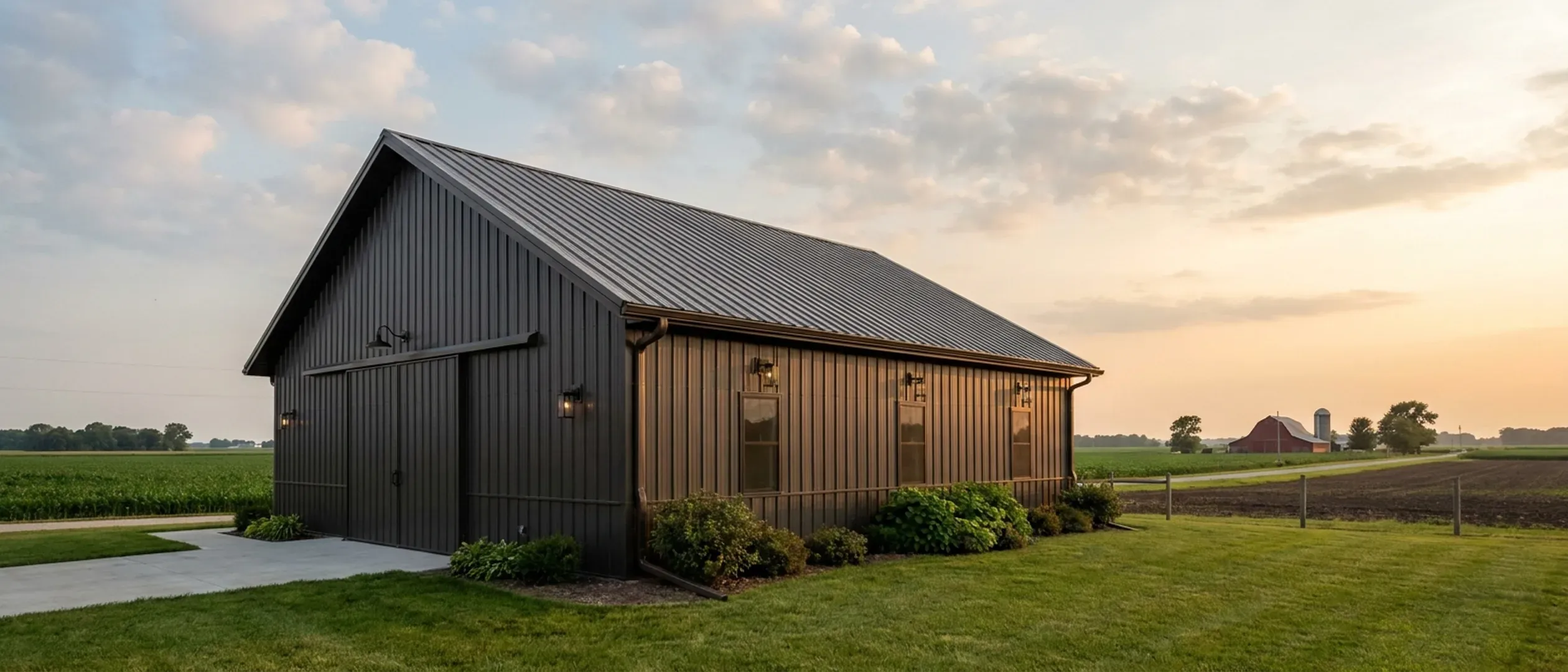
How Long Does It Take to Build a Barndominium in Indiana?
How long does it take to build a barndominium? Nobody can honestly give one number, because most of the calendar is spent on things that are not construction: finding out what the land allows, getting the soil evaluated for a septic system, the zoning permit, the building permit where one exists, and waiting for ground that is not frozen. What Indiana does offer is a set of published clocks. The state septic rule gives the local health department 30 days to decide a complete septic permit application, and a 2025 law gives cities, towns and counties that permit houses three business days to say whether an application is complete, seven business days for plan review and three business days to inspect after a request. This page sets out the order the approvals have to happen in, the time limits each one carries by law, and the seasonal facts that decide when concrete can go in. It does not promise a build duration, and it quotes none of our own.
Figures on this page are cited third-party or government data, not a quote from Indiana Barndominium Builders.
Bottom Line Up Front
- The order is fixed by the rules, not by preference: the septic soil evaluation comes before the septic permit application, the septic permit comes before construction of the house starts, and where a city, town or county requires a building permit, its application schedule can require zoning, drainage, septic, well, driveway and flood-control approvals before you apply.
- Indiana puts clocks on the approvals. The local health department must issue or deny a complete septic construction permit within 30 days. Where a unit permits houses, Indiana Code 36-7-2.5 gives it three business days to confirm an application is complete and seven business days to finish plan review, lets you use a private plan reviewer and inspector instead, and makes a unit that misses its deadlines forfeit its fees.
- Winter moves the footing pour, not the paperwork. Indiana's residential code says footings 'shall not bear on frozen soil', the required depth is 24, 30 or 36 inches depending on the county, and some counties close their roads to heavy trucks during the thaw — Newton County bans vehicles over five tons on county roads from 1 February to 1 April.
The Indiana order of operations
Each step depends on the one before it. The dates that matter are the ones set by rule; the rest depend on the parcel, the weather and the trades.
1. Land: what the parcel allows
Before buying or designing, find the zoning district and its minimum floor area and accessory-building rules, any subdivision covenants, whether the land is in a regulatory floodway (a residence there needs a DNR permit under Indiana Code 14-28-1 before anything else), and whether a local office permits houses at that address. The DHS directory of local building officials is the starting point for the last question; the county or town confirms it.
2. Boundary and site plan
Zoning offices and health departments work from a site plan showing the house, the septic area, the well and the drive against the property lines. Where the lines are uncertain, a boundary survey by a registered land surveyor you hire is the document that settles them. Placing the septic area comes before placing the house, because the soil decides it.
3. Soil evaluation and the septic permit
A soil scientist describes the soil profile to five feet or to a layer that cannot be readily penetrated. The application then goes to the county health department with the number of bedrooms, the soil evaluation and the system plans, and the department has 30 days from a complete application to issue or deny. Keep equipment off the septic area from this point: under section 53(h) of the rule, cutting, scraping, compaction, fill or soil removal after the evaluation means a new evaluation before the system can be built.
4. Zoning: the improvement location permit
Indiana Code 36-7-4-801 lets a zoning ordinance require an improvement location permit for any structure on platted or unplatted land. Many rural Indiana counties issue one even where they do not run residential building permits, and where a unit does permit houses it can require zoning approval before it accepts the building permit application.
5. Plans
Indiana's residential code leaves plan requirements for one- and two-family dwellings to local ordinance. Plans should carry the county's footing depth and ground snow load from the state table, the energy-code insulation values for the county's climate zone, and the post-frame or steel frame design from the package supplier or a design professional you hire.
6. The building permit, where one exists
Where a unit requires one, its published schedule lists the documents and prior approvals a complete application needs. Three business days to confirm completeness, seven business days for plan review after that, or a private provider instead: those are the statutory clocks in Indiana Code 36-7-2.5.
7. Construction and inspections
Footings to the county frost depth on unfrozen ground; the shell; rough-in plumbing, electrical and mechanical; insulation; finishes. Where a unit inspects, it must say whether it can inspect within three business days of a written request, and a private provider can inspect instead. The septic installer must give the health officer notice before any subsurface part is covered — at least 48 hours or two working days where the local board has not published its own procedure.
8. Occupancy and loan conversion
Where the unit issues a certificate of occupancy or a certificate of completion and compliance, that is the last approval and the document a construction lender converts on. Where none is issued, the lender's own completion inspection and appraisal update decide conversion, on whatever evidence you agreed at closing.
Clocks that are set in writing
These are the only durations on this page, and each one comes from the rule or the statute quoted. Everything else depends on the parcel.
30 days: septic permit decision
410 IAC 6-8.3-53(g): the local health department issues or denies a residential septic construction permit within 30 days of receiving the application and plans. The clock runs from a complete submittal, which includes the soil scientist's evaluation.
3 and 7 business days: completeness and plan review
Indiana Code 36-7-2.5-16 and -17: a unit that permits houses has three business days to notify you whether an application is complete, three business days after each set of revisions, and seven business days after confirming completeness to finish plan review. Delays outside the unit's control or caused by the applicant do not count.
3 business days: inspection
Indiana Code 36-7-2.5-18: the unit's completeness notice must say whether it can provide inspections within three business days of a written request. If it cannot, a private provider can, at the applicant's expense.
12 and 18 months: the construction loan
For single-close construction-to-permanent loans it buys, Fannie Mae allows no single construction period over 12 months and no more than 18 months in total, and wants the appraisal dated no more than four months before the loan closes. Lenders who sell to Fannie Mae plan around those limits, so approvals should be in hand before closing.
Seasons and ground conditions
Indiana's weather does not change the approvals, but it decides when the ground work can happen.
No footings on frozen soil
Indiana's frost-protection amendment says footings shall not bear on frozen soil unless the condition is permanent. A late-autumn start that misses the footing pour before the ground freezes can wait for spring, or pay for protecting the excavation.
No mound systems on frozen or wet soil
Where the soil requires an elevated sand mound, 410 IAC 6-8.3-84 says site preparation, tilling, construction and finish grading must not be performed when the soil is frozen, or when it is wet enough at installation depth to exceed its plastic limit. A mound site in a wet spring can hold the whole schedule.
Thaw-season road limits
County frost laws, such as Newton County's February-to-April ban on vehicles over five tons, can stop concrete and steel deliveries on county roads. They do not apply on state roads, U.S. highways or town streets there. The dates are set by each county.
Wet ground and drainage
Purdue's drainage guide reports that about half of Indiana's cropland is artificially drained. Farm tile crossing a building site or septic area has to be found and dealt with before excavation, and wet ground slows site work in any season.
What quietly costs weeks
None of these is a rule. Each is a place where the order above breaks down.
Disturbing the septic area
Driving loaded trucks across the evaluated septic area, stockpiling fill on it or grading it for the house pad triggers a new soil evaluation under the septic rule. Flag the area off on the first day of site work.
An incomplete application
The statutory clocks start from a complete application. Missing a prior approval the unit's schedule requires — drainage, driveway, well — resets the three-day completeness exchange until it is supplied.
Changing the bedroom count
The septic system is sized at 150 gallons per day per bedroom under the state rule. Adding a bedroom, or a jetted tub over 125 gallons, after the permit means a revised septic design and approval.
Discovering there is no permit to get
On a parcel with no local building department, the construction may start sooner, but the lender's completion evidence has to be arranged instead. Finding that out at loan conversion costs more time than finding it out at the first meeting.
Ordering the steel before the permits
A steel or post-frame package has its own fabrication and delivery lead time. Ordering it before zoning and septic are approved risks a package sitting on site, or one that no longer matches a plan the zoning office asked you to change.
Reading this because you are weighing a build? The next step is a plan drawn for your program.
What's different about Indiana
The septic permit has a 30-day clock — and comes before the house
Indiana's residential septic rule, 410 IAC 6-8.3, is administered by local boards of health. Section 53 requires the owner to obtain a written septic construction permit signed by the health officer before the start of construction of a residence, and says that 'In accordance with IC 16-41-25-1(a), the local health department shall issue or deny' the permit 'within thirty (30) days of receipt of an application and plan submittal'. Section 56 requires the soil at the site to be described by a soil scientist, and says the on-site evaluation 'shall be conducted before application and plan submittal'. So the soil scientist's visit is the first date on any Indiana rural build calendar, and the 30 days only start once a complete application is in.
Where a unit permits houses, state law sets its review times
Indiana Code 36-7-2.5, enacted in 2025, applies to any county, city or town that requires a permit, plans, plan review, inspection or a certificate of occupancy for a one- or two-family dwelling. The unit must tell the applicant within three business days whether the application is complete, finish plan review within seven business days after confirming it is complete, and say whether it can inspect within three business days of a written request. If the unit says it can meet the plan-review time and then does not, it must issue a permit or a limited permit by the next business day. A 2026 amendment adds that a unit missing the chapter's deadlines forfeits and refunds its regulatory fees, unless the delay was outside its control or the applicant's fault.
You can use a private plan reviewer and inspector
The same chapter lets an applicant use a private provider for plan review, inspections or both, whether or not the unit could meet its deadlines. A private provider must be a registered architect, a professional engineer or an ICC-certified building official, must not be connected to the project, and must carry professional liability coverage of at least $1,000,000 per claim and $2,000,000 aggregate, per the statute. The applicant pays the provider, and the unit may charge a convenience fee of no more than $100 where it refunds its own review fees. On a tight construction-loan schedule, that option is the main lever Indiana law gives you over permit time.
Where no local office permits houses, there is no permit step — and no certificate
Indiana's residential code applies everywhere, but the Department of Homeland Security says that where there is no local authority 'the residential issue becomes a private civil matter'. Its directory of local building officials lists a state inspector, not a local official, for the unincorporated area of 24 counties. On such a parcel the building-permit step may drop out of the calendar, but the septic permit and any zoning improvement location permit do not, and the certificate of occupancy a construction lender expects will not exist. Settle with the lender, before closing, what completion evidence replaces it.
Footing depth and frozen ground
The 2020 Indiana Residential Code's county table sets the minimum footing depth at 36 inches in 27 northern counties such as Allen, Lake and St. Joseph, 30 inches in 29 central counties including Marion and Hamilton, and 24 inches in 36 southern counties including Vanderburgh and Monroe. Indiana's amendment to the frost-protection section adds that 'Footings shall not bear on frozen soil unless the frozen condition is permanent.' The winter design temperatures in the same table are 1 °F in the northern band, 2 °F in the central band and 9 °F in the southern band. In practice, the pour waits for thawed ground at footing depth or for frost protection of the excavation; the rule itself does not set dates.
Spring road limits can hold up deliveries
Some Indiana counties restrict heavy vehicles on county roads while the road base thaws. Newton County's highway department says its Frost Law 'officially begins on February 1st and runs through April 1st', that 'Any vehicle weighing over 5 tons is prohibited from traveling on county roads during this period', and that 'No permits will be given', with exemptions for school buses, milk, garbage, feed, animal, fuel and LP trucks. It does not apply to state roads, U.S. highways or town streets. A loaded concrete truck or a steel package delivery is far over five tons, so on a county-road parcel in a county with a frost law, late-winter deliveries depend on the county's dates. Ask your county highway department whether it posts one.
Pros and cons, honestly
Pros
- Indiana puts written clocks on the septic permit decision and, where a unit permits houses, on completeness review, plan review and inspections.
- An applicant can use a private plan reviewer and inspector instead of waiting on the local office.
- A unit that misses the statutory deadlines forfeits its regulatory fees under a 2026 amendment.
- A barndominium shell dries in quickly once the footings are in, which moves interior trades indoors sooner.
- The county design figures are published in one state table, so the footing depth and snow load are known before design starts.
Cons
- The septic soil evaluation, application and permit all have to come before construction of the house starts.
- Footings cannot bear on frozen soil, so an autumn start can slip to spring.
- County thaw-season road limits can stop heavy deliveries on county roads for weeks.
- Disturbing the evaluated septic area during construction requires a new soil evaluation.
- Where no local office permits houses, there is no certificate of occupancy for a lender to convert on.
- A construction loan's clock runs from closing, so approvals left until after closing spend it.
How long does it take to build a barndominium in Indiana?
What has to happen before construction can start?
Can you pour barndominium footings in winter in Indiana?
How long does a septic permit take in Indiana?
What if the building department is slow?
Do I need a building permit for a barndominium in Indiana?
Does a barndominium go up faster than a regular house?
When should I close on the construction loan?
Questions answered? Tell us what you want to build and we will put real numbers against it.
Keep reading
The pages that answer the next question this one raises.
Barndominium financing in Indiana
How the construction loan's clock and the certificate of occupancy question fit the schedule.
Read itAre barndominiums legal in Indiana?
Who permits and inspects a house in Indiana, and where nobody does.
Read itSite preparation
Soil, drainage tile, the septic area and the house pad, in the right order.
Read itPermitting
Assembling the septic, zoning and building applications so the statutory clocks start.
Read itStart your project survey
Tell us where the land is and we will lay out the approvals and their order for that parcel.
Read itSources
- Indiana Code Title 36 (2026) — Indiana General Assembly
- 410 IAC 6-8.3 Residential On-Site Sewage Systems (rev. 28 Mar 2024) — Indiana Department of Health
- 675 IAC 14-4.4-43 (Indiana Residential Code, R403.1.4.1 frost protection) — Cornell LII
- 675 IAC 14-4.4-5 (Indiana Residential Code, Table R301.2(1) county design criteria) — Cornell LII
- Frost Law Information — Newton County, Indiana
- Code Enforcement — Indiana Department of Homeland Security
- Local Building Official list for the State of Indiana — Indiana Department of Homeland Security
- Indiana Code Title 14 (2026) — Indiana General Assembly
- Selling Guide B5-3.1-02, Construction-to-Permanent Financing: Single-Closing Transactions — Fannie Mae
- Selling Guide B5-3.1-01, Construction-to-Permanent Financing: Overview — Fannie Mae
- Indiana Agricultural Drainage Guide: introduction — Purdue University
- Indiana Code Title 25 (2026) — Indiana General Assembly
Want a real number instead of a range?
Start your plans and we will come back with a budget for what you actually want to build, not a national average. Send the parcel ID or an address when you have one and we will price it against your land. That conversation costs nothing.